
Why Smart Kenyan Punters Track Bookmaker Margins, Payout Speeds, and RTP in 2026
Walk into any football viewing lounge in Nairobi, Kisumu, or Eldoret on a Saturday afternoon and you will hear intense debates over Premier League team news, FKF Premier League form tables, and Both Teams to Score (BTTS) trends. Yet ask ten regular punters why two people backing the exact same match selections end up with completely different account balances at the end of the month, and very few point to the underlying mathematics of the slip itself.
In modern sports analysis, picking winners is only half the battle. Long-term profitability in Kenya’s mobile betting market comes down to three structural factors that operate quietly behind every ticket: the bookmaker’s built-in overround margin, M-Pesa settlement and withdrawal speed, and the Return-to-Player (RTP) math of instant multiplier games.
Here is a practical breakdown of how each factor affects your wallet—and how data-driven bettors audit them before locking in a stake.
1. The Hidden Tax in 1X2 and Over/Under Markets: Bookmaker Overround
Every time you look at decimal odds for a three-way (1X2) or two-way (Over/Under 2.5 Goals) market, you are looking at implied probabilities plus a house fee known as the overround or vig.
In a truly fair coin-toss match between two evenly matched sides, each outcome has a 50% chance of happening, which translates to fair decimal odds of 2.00 on either side. In practice, however, a sportsbook might price both outcomes at 1.85. When you convert those odds into implied probability using the formula (1 / Decimal Odds) × 100, each 1.85 outcome equals 54.05%. Added together, the total market equals 108.1% instead of 100%. That extra 8.1% is the bookmaker’s built-in margin.
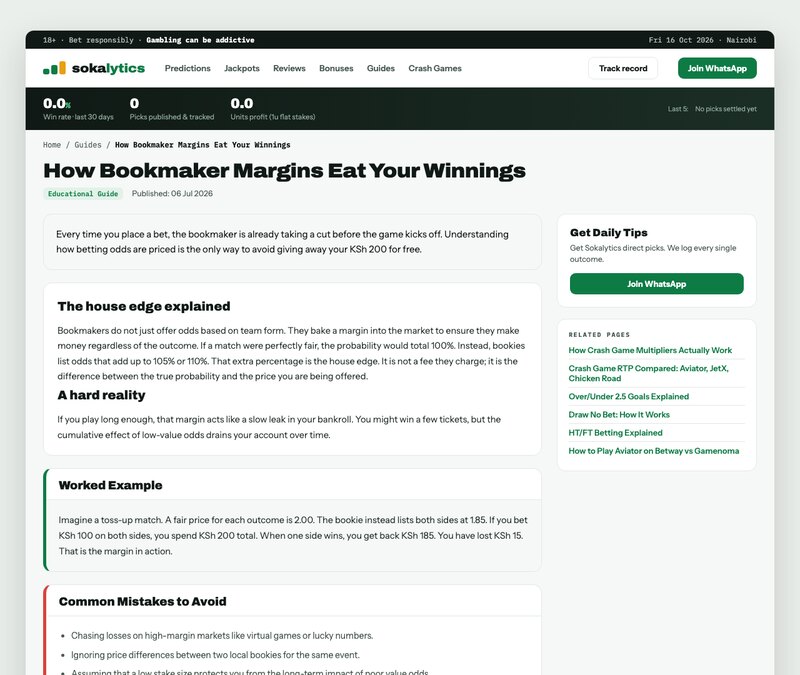
Why does a difference of 3% or 4% matter so much? Because on a five-leg weekend multibet, bookmaker margins compound multiplicatively:
- Single Match (4.5% margin): ~4.5% house edge (95.5% effective fair value returned)
- 3-Leg Weekend Treble (6.5% margin per leg): ~18.3% compounded house edge (81.7% effective return)
- 5-Leg Accumulator (8.5% margin per leg): ~35.9% compounded house edge (64.1% effective return)
Before combining multiple fixtures into an accumulator, disciplined analysts spend two minutes calculating bookmaker overround margins across different markets. Often, shifting from a heavily taxed 1X2 market to a cleaner two-way market like Draw No Bet or Asian Lines immediately trims the house edge and preserves your bankroll over a 30-day cycle.
2. Liquidity and M-Pesa Execution Speed for Live and Multi-Window Betting
Even when you find genuine value in pre-match or live odds, capital efficiency determines whether you can act on it. Kenyan punters overwhelmingly manage their sportsbooks through Safaricom M-Pesa rather than leaving large idle balances sitting across five different bookmaker wallets.
During a packed Saturday matchday—when an early 3:30 PM kickoff settles just before the 6:00 PM and 8:30 PM European fixtures begin—having winnings locked in pending review or delayed by manual verification queues carries a real opportunity cost:
- Missed Line Value: Sharp odds on late kickoffs often shorten 30 to 45 minutes before kickoff once starting lineups drop.
- Re-Deposit Friction: If a platform delays a withdrawal, bettors are forced to dip into fresh M-Pesa funds rather than recycling their settled profit unit.
- Emotional Tilt: Unclear transaction histories or buried withdrawal menus frequently tempt players into cancelling a pending cashout and placing impulsive live bets.
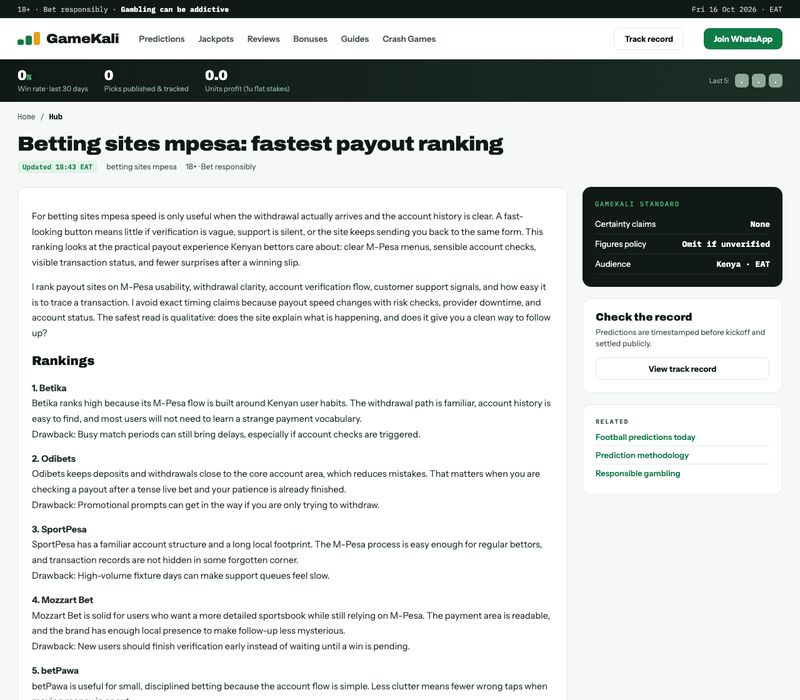
When auditing operators, experienced punters look beyond promotional banners and check independent evaluations of the fastest M-Pesa payout betting sites. Platforms that integrate clean STK Push deposit prompts alongside automated Business-to-Customer (B2C) disbursement rails—and display transparent transaction IDs inside your account history—allow you to move a single KSh 1,000 or KSh 5,000 working bankroll fluidly from match window to match window.
3. Fixed-Odds Margins vs. Provably Fair Multiplier Games (97% RTP)
What happens during halftime, rain delays, or slow midweek international breaks when the football fixture list offers thin value? Many Kenyan punters diversify a small, capped entertainment portion of their balance into instant multiplier or crash games such as Aviator, Paka Kumi, or Chicken Dash.
From a purely mathematical standpoint, the reason instant crash games have grown so rapidly alongside football betting comes down to Return-to-Player (RTP) transparency:
- Higher Theoretical Return: While a five-leg football accumulator might carry a compounded house edge of 25% to 35%, top-tier crash games operate on a fixed 97% RTP (a flat 3% house edge).
- Cryptographic Provable Fairness: Modern crash engines combine a server seed with client seeds via SHA-256 hashing before the round starts, allowing any player to verify that the crash point was not manipulated based on their stake size.
- Granular Risk Control: Features like Auto Cash Out (for example, locking in an automatic exit at
1.50xor2.00x) and micro-stakes starting from KSh 10 remove manual hesitation.

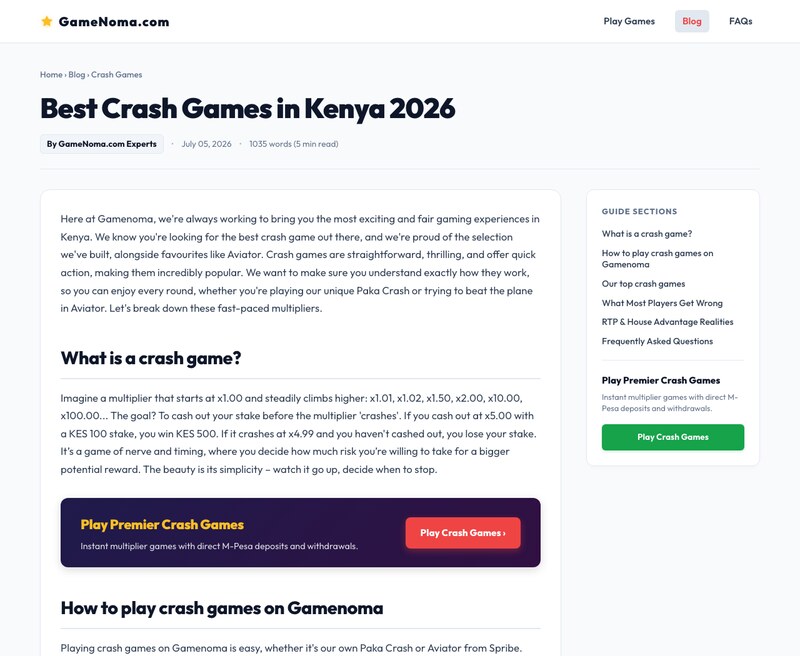
If you are exploring how local titles like Paka Kumi (Paka Crash), Lwanda Magere, and Athlete Hurdles compare against Spribe’s Aviator, reviewing a dedicated breakdown of the best crash games in Kenya helps you understand multiplier volatility, minimum KSh 10 stake limits, and why setting a pre-round Auto Cash Out target is essential for protecting your session balance.
4. A 4-Point Pre-Match Checklist for Kenyan Punters
Whether you are building a Saturday 1X2 slip or playing a quick halftime multiplier round, running through these four rules keeps the math in your favour:
- Check the Overround First: Add the implied probabilities of all match outcomes before betting. Aim for two-way or sharp three-way markets under 105%–106% total implied probability.
- Keep Multibets Compact: Every extra leg multiplies the bookmaker’s margin. Two-leg doubles and three-leg trebles preserve far more expected value than 12-leg lottery slips.
- Prioritize Instant M-Pesa Liquidity: Stick to verified platforms with automated STK Push deposits and instant B2C M-Pesa withdrawals so your capital is never trapped during peak Saturday traffic.
- Separate Sports and Instant Game Budgets: If you play 97% RTP crash games, ring-fence a strict session limit and use automated cashout triggers rather than chasing high multipliers manually.